
How the passport became the world's rite of passage
Does a passport actually prove you're a citizen? The answer says less about identity than about centuries of states fighting to control who crosses their borders
Does a passport actually prove someone is a citizen of the country that issued it? The question sounds simple, but it opens up layers of history most of us never think about when we hand our passport to an immigration officer.
The passport, i fact, grew up a
'The invention of the passport’ (2000)
The passport, in fact, grew up alongside the modern state itself. As historian John Torpey argues in The Invention of the Passport (2000), the ability to cross borders came to depend more and more on political authority rather than private arrangement. Over centuries, as systems of forced labour declined, states gradually stripped private entities of the power to control people's movement and claimed that power for themselves.
Before the modern passport
Something like a travel permit existed long before the nation-state. Some trace the idea as far back as biblical times, though this is hard to verify with certainty. The Book of Nehemiah, dating to around the fifth century BCE, describes how the Persian king Artaxerxes gave Nehemiah letters instructing governors west of the Euphrates to let him pass safely into Judea.
In Western Europe, one of the earliest ancestors of the modern passport was the safe-conduct, a document rulers used to assert control over movement within their territory.
Merchants were among the first to be issued one. It typically carried the bearer's name and the reason for the journey. By the sixteenth century, as European borders hardened, safe-conducts became a common sight across the continent.
Further east, Peter the Great gave documentary travel control a major push in Russia. As part of his broader push to modernise and strengthen the state, he brought in rules to track people's movements. This included an edict in 1719 requiring anyone travelling between towns to carry a pass issued by a superior.
Passport controls were just as central to royal authority in pre-revolutionary France. Torpey notes that among the grievances of the French revolutionaries was a 1669 edict of Louis XIV that banned subjects from leaving French territory without a passport authorising the trip.
A revolution in mobility
Attitudes toward free movement shifted sharply after Louis XVI's failed escape from France on June 21, 1791. The National Assembly responded by halting all departures from the kingdom, and the very next day, Paris's mayor decreed that only those holding a state-issued passport could leave the city.
King Louis XVI on June 21, 1791
King Louis XVI on June 21, 1791
The defeat of Napoleon and
Congress of Vienna
That grip loosened after Napoleon's defeat. The Congress of Vienna in 1815 stabilised relations between European states, and the years that followed brought expanding railways, growing trade, and liberal political ideas — all of which pushed borders open again. By the late nineteenth century, passports had become largely optional across much of Western Europe. France scrapped passport requirements for internal travel in 1861, and Britain became one of the loudest champions of passport-free international travel.
Congress of Vienna
Congress of Vienna
For a brief window, many Europeans could travel across the continent with nothing more than a visiting card or a letter of introduction. That freedom vanished almost overnight with the outbreak of the First World War.
War brings the passport back
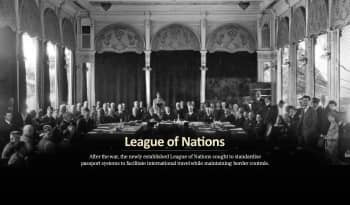
The First World War is the single biggest turning point in passport history. Nearly every country at war reimposed passport controls, driven by security concerns and a desire to stop skilled workers from emigrating. Once the war ended, the newly formed League of Nations tried to bring order to the resulting patchwork of national systems. Its passport conferences in 1920 and 1926 introduced features still in use today — standard booklet sizes, fixed page layouts, and the now-familiar photograph.
The return of passports did not go down well. British tourists in the 1920s complained bitterly about having to attach photographs and submit to physical descriptions, calling it, in the words of historian Michael Marrus, a "nasty dehumanisation."
Americans felt much the same. Historian Craig Robertson, in The Passport in America, quotes a Washington Post report from the period in which a traveller described the process as deeply humiliating, adding that passport officials often seemed to treat every applicant as a suspected spy until proven otherwise.
Nansen passport
The war's aftermath also created a refugee crisis, and the League of Nations responded in 1922 with the Nansen passport — a document issued to stateless refugees that let thousands of displaced people cross borders, find work and rebuild their lives. It faded away as international refugee protections evolved in the following decades.
Toward the passport we know today
The postwar boom in international air travel made a strong case for globally standardised passports. In 1980, the International Civil Aviation Organization published Doc 9303, setting international standards for machine-readable travel documents. Rather than forcing every passport to look identical, it standardised the essentials — booklet size, the identity page, details like name, nationality, date of birth, passport number, issue and expiry dates, and a machine-readable zone.
That standardisation made it possible for passports from different countries to be read electronically, setting the stage for the biometric passport that followed in the late 1990s and early 2000s.
The biometric passport carry an embedded microchip holding the owner's personal details and biometric data — a digital photo, and in some countries fingerprints or iris scans — allowing authorities to verify identity far more reliably.
Today, more than a billion biometric passports are in circulation, issued by upwards of 140 authorities around the world.
 Built with Shorthand